
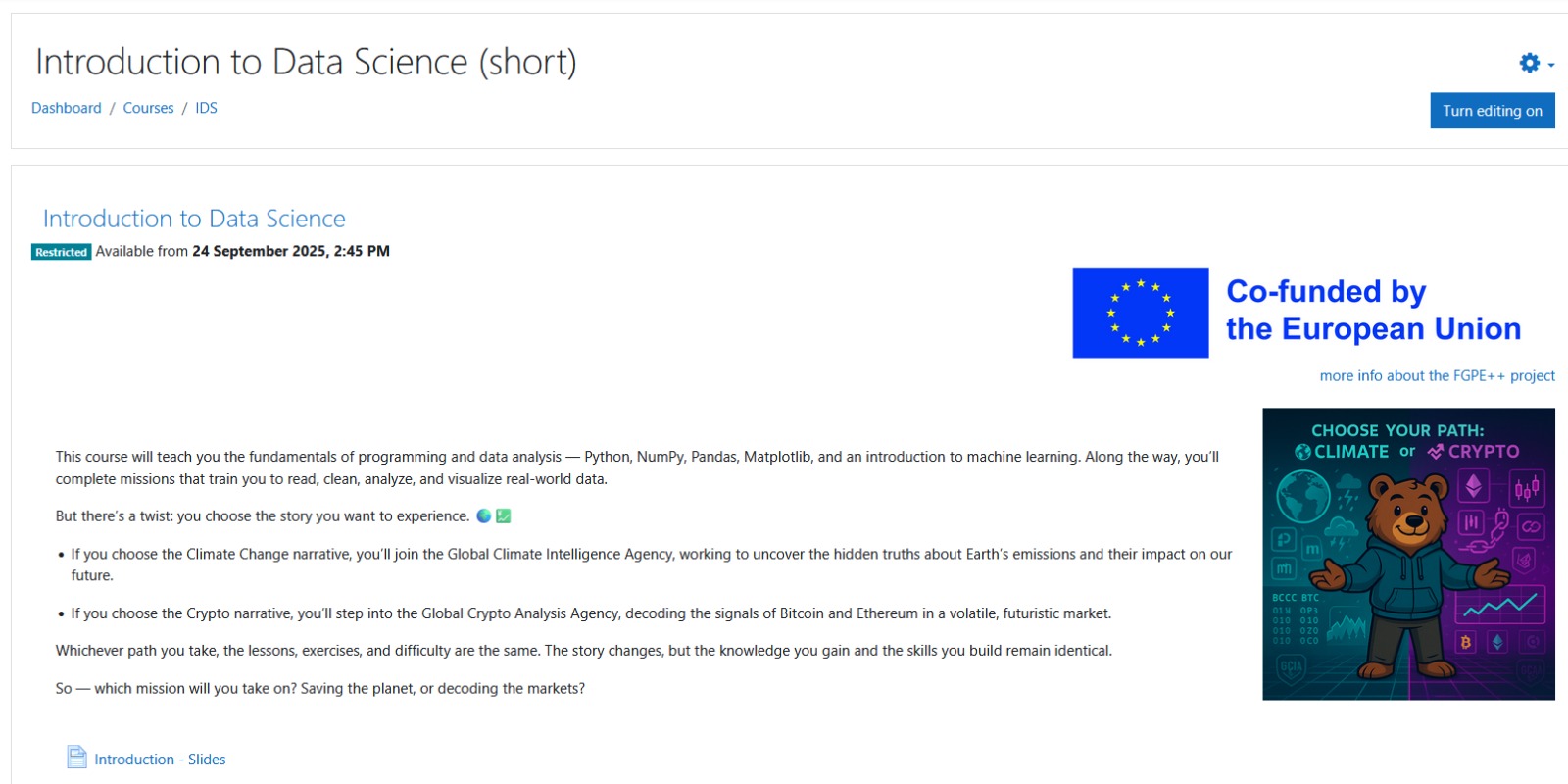
The various online educational tools work best if connected. To illustrate the FGPE platform’s capability in this regard, a multilevel-gamified FGPE-supported course for Moodle LMS has been developed, integrating low-level gamification of programming exercises provided by the FGPE platform and high-level gamification provided by Moodle LMS, integrated via the LTI standard, allowing seamless automatic data interchange between the two e-learning platforms.
The full-fledged gamified programming course with embedded FGPE-run exercises can be used in both a closed institutional LMS environment or as a MOOC. The course is released under the Creative Commons BY 4.0 open license, so that any educational institution can use it and, if necessary, adopt it for their specific purposes free of charge. The course can be downloaded from the following URL: https://drive.google.com/file/d/11q8QEq1dcZkVUrIvJDRgoNGXrDpIqNNj/view?usp=sharing.
The developed course teaches the fundamentals of programming and data analysis, covering Python, NumPy, Pandas, and Matplotlib, along with an introductory module on machine learning. Through a sequence of missions and gamified challenges, learners develop essential skills in reading, cleaning, analyzing, and visualizing real-world data.
A distinctive feature of the course is its narrative-driven structure, where learners can choose the storyline they want to experience while progressing through identical learning content:
• Climate Change Narrative: Learners join the Global Climate Intelligence Agency, investigating global emissions data to uncover hidden patterns and understand their implications for the planet’s future.
• Cryptocurrency Narrative: Learners operate as analysts in the Global Crypto Analysis Agency, exploring and decoding data related to Bitcoin, Ethereum, and broader digital-market dynamics in a fast-paced, futuristic environment.
Although the narratives differ, the underlying lessons, exercises, and level of difficulty remain the same. This dual-story design enriches the learning experience without compromising pedagogical consistency.
The course has been developed in a shared effort of the FGPE++ project team members. More information on the concept and development of the course can be found in the published research paper which received the Best Paper Award at the ICPEC 2025 conference:
Bauer, Y., Leal, J. P., Queirós, R., Swacha, J., & Paiva, J. (2025). Designing a Multi-Narrative Gamified Learning Experience. In R. Queirós, M. Pinto, F. Portela, & A. Simões (Eds.), 6th International Computer Programming Education Conference (ICPEC 2025) (Vol. 133, p. 15:1-15:8). Schloss Dagstuhl – Leibniz-Zentrum für Informatik. https://doi.org/10.4230/OASIcs.ICPEC.2025.15
The demonstrational videos below show the developed gamified course: (1) as seen by a student learning from it (especially note the switch at 2:30 from Moodle to FGPE PLE platform to solve a programming exercise embedded in the course without a need for re-logging thanks to passing user credentials via LTI) and (2) as seen by a teacher supervising the students (especially note the grade report from 0:22, based on student progress data automatically retrieved by Moodle from the FGPE platform via LTI).